

An electrical engineer who previously demonstrated experimentally the

(PhysOrg.com) -- For more than two decades, scientists have been "watching" electrons in atoms make the jump between energy levels in real time. "Atoms have energy levels, and when electrons

When black holes slam into each other, the surrounding space and time surge and undulate like a heaving sea during a storm. This warping of space and time is so complicated that physicists haven

A team of physicists experimentally produces quantum-superpositions, simply using a mirror.

A new way of understanding the structure of proteins, polymers, minerals, and engineered materials will be published in the May 2011 issue of the journal Nature Materials. The discovery by two Penn State University researchers is a new type of symmetry in the structure of materials, which the researchers say greatly expands the possibilities for discovering or designing materials with desired properties. The research is expected to have broad relevance in many development efforts involving physical, chemical, biological, or engineering disciplines including, for example, the search for advanced ferroelectric ferromagnet materials for next-generation ultrasound devices and computers. The paper describing the research will be posted early online by the journal on 3 April 2011, prior to its publication in the journal

Quantum physicists have now achieved controlled entanglement of 14 quantum bits (qubits) and, thus, realized the largest quantum register that has ever been produced. With this experiment the scientists have not only come closer to the realization of a quantum computer but they also show surprising results for the quantum mechanical phenomenon of entanglement.

What’s the News: This week, scientists say that they’ve passed a chemistry milestone by creating the world’s first practical photosynthesis device. The playing-card-sized photosynthetic gadget uses sunlight to split water molecules into oxygen and hydrogen, which can then be used to produce energy, and is reputedly 10 times more efficient than a natural leaf. Researchers …

(PhysOrg.com) -- Scientists from the U.S. Department of Energy

(PhysOrg.com) -- In the classical world, information can be copied and deleted at will. In the quantum world, however, the conservation of quantum information means that information cannot be created nor destroyed. This concept stems from two fundamental theorems of quantum mechanics: the no-cloning theorem and the no-deleting theorem.

Picture a metal that
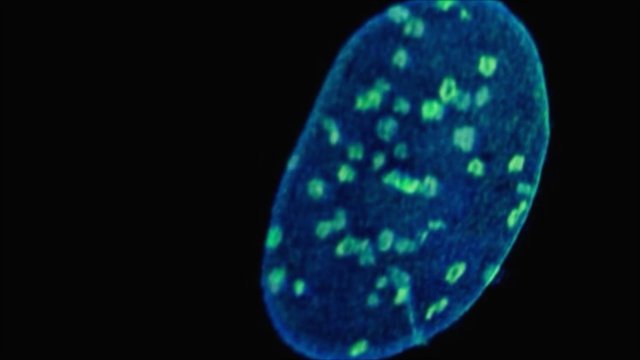
A technique to image living cells in action, in an unprecedented mix of detail in both time and space, is described by researchers.

Physicists have for the first time caused a gas of atoms to exhibit an important quantum phenomenon known as spin-orbit coupling. Their technique opens new possibilities for studying and better understanding fundamental physics and has potential applications to quantum computing, next-generation

A physician-researcher has developed a personalized therapy to treat a wide range of cancers. The treatment is based on a naturally occurring human enzyme that has been genetically modified to fool cancer cells into killing themselves.


