
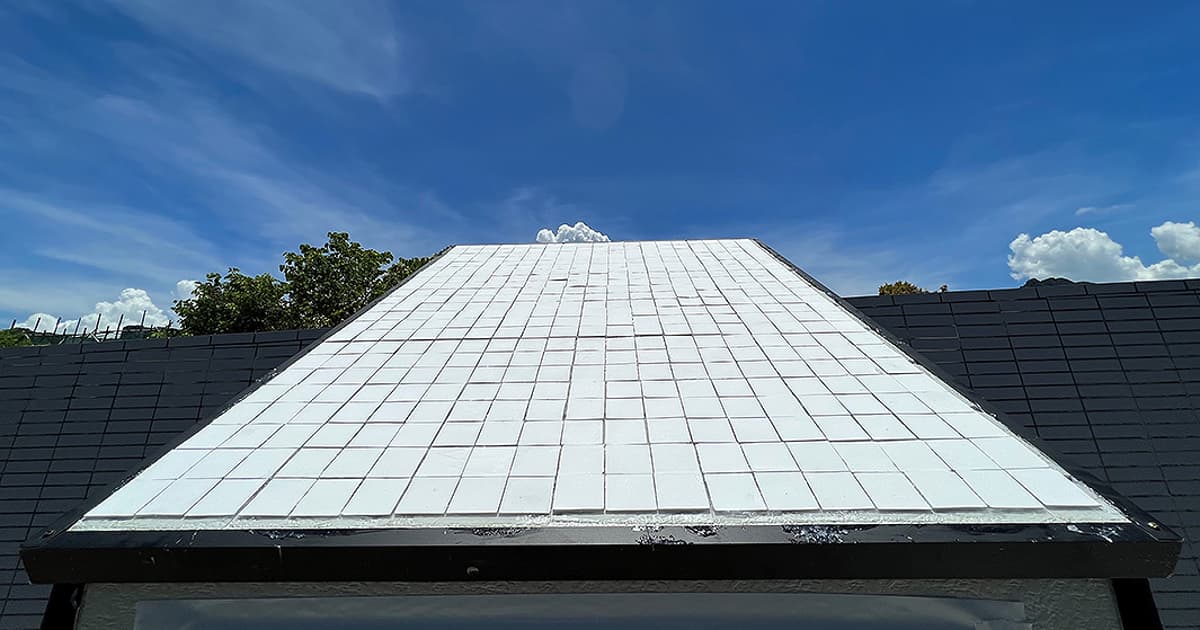
Scientists in Hong Kong have demonstrated a new ultra-white ceramic material that can drastically cool buildings by reflecting sunlight and heat at record highs.

Scientists have discovered a strange new form of crystal that was forged in the world's first nuclear weapons test. Known as a "quasicrystal", the curious creation is arranged in an extremely rare atomic structure.

Every lunar swirl identified to date coincides with a magnetic field over the lunar surface, which scientists think deflects solar particles. There also seems to be a connection between lunar swirls and lava tubes buried beneath them.

To accurately measure the Universe on the smallest scales, you need a laser with the perfect mix of power and precision.

The chances of finding extraterrestrial life have improved slightly after NASA announced that its Hubble Space Telescope has confirmed the size of an Earth-sized exoplanet only 22 light-years from Earth.

Down the deep and dark passageways of Mexico's mysterious underwater labyrinth, known for preserving incredible Maya relics, dwells a staggering wealth of microbial life.

Nearly five times more people will likely die due to extreme heat in the coming decades, an international team of experts said Wednesday, warning that without action on climate change the "health of humanity is at grave risk".

When future astronauts explore Mars's polar regions, they will see a green glow lighting up the night sky. For the first time, a visible nightglow has been detected in the martian atmosphere by ESA's ExoMars mission.

A recent deep field image from the Webb Space Telescope features two galaxies. These galaxies are remarkable for their distance from Earth, being the second and fourth most distant galaxies ever observed.

Scientists have spotted a stunning "aurora-like" display of crackling radio waves over the surface of the sun that is strikingly similar to the Northern Lights on Earth.

Cuttlefish in the present study were all able to wait for the better reward and tolerated delays for up to 50-130 seconds, which is comparable to what we see in large-brained vertebrates such as chimpanzees, crows and parrots.

The burst that originated some 2.4 billion light-years away from Earth and struck the planet on 9 October last year may have led to changes in the upper ionosphere, according to a new study.

Every 76 minutes, like clockwork, the gamma-ray flux of Sagittarius A*, the supermassive black hole in our galaxy, fluctuates, suggesting an orbital motion of something whirling madly around the black hole.

Instruments on NASA's Webb telescope are providing new clues about the time window when planets can form around a young star.

A new study finds that Earth itself has a pulse, with one “beat” every 27.5 million years. That’s the rate at which major geological events have been occurring as far back as geologists can tell.


