
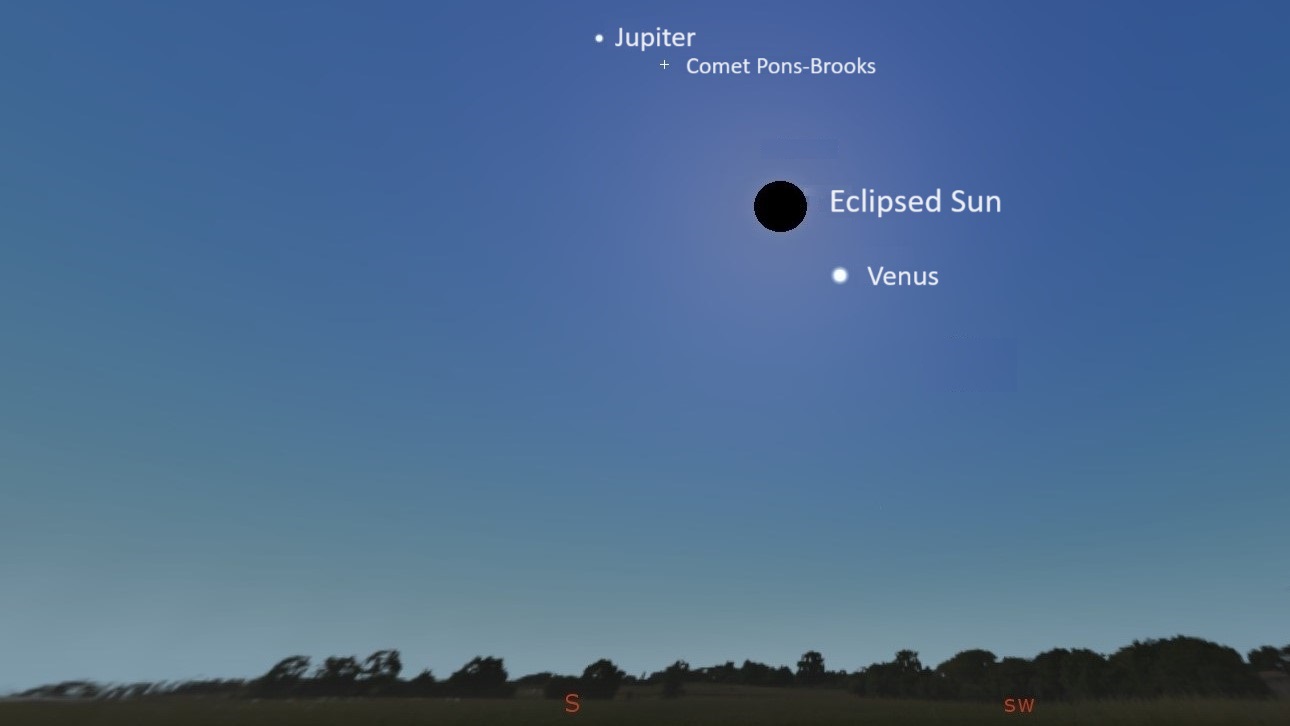
Comet Pons-Brooks visits the inner solar system every 71 years. Its next perihelion (when it’s closest to the sun) will be on April 21, 2024.

A newly developed silicon material covered with tiny nanospikes is capable of taking out 96 percent of the virus particles unfortunate enough to touch its surface in tests.

The early-stage research - which saw 99 % of melanoma cells eradicated in a lab - could provide new cancer treatment options, experts say.

The Earth's atmosphere just pulled a surprising U-turn! The polar vortex, a swirling mass of cold air circling the Arctic, has unexpectedly reversed its direction.

A world infamous for its hellacious conditions may have just been seen spotting one of the prettiest phenomena ever to grace Earth's own atmosphere.

The White House in U.S. has recently directed NASA to establish a unified standard of time for the moon and other celestial bodies.

For decades, the pursuit of quantum computing has struggled with the need for extremely low temperatures, mere fractions of a degree above absolute zero.

Combining results of laboratory studies on the infra-red glow of carbon molecules in simulation software has led a team of researchers to a new discovery about the creation of spherical carbon 'cages' called fullerenes.

South Korean researchers have maintained plasma temperatures of 100 million degrees Celsius for 48 seconds inside a tokamak fusion reactor.

Chemicals found in common household disinfectants, glues, and furniture textiles could damage supporting cells in the brain during critical stages of their development, a new study based on human cell cultures and mice has found.

Authorities in New Zealand are investigating an unfortunate incident in which thousands of juvenile eels washed up in the Kauritutahi stream. The massive deaths marked the second time in the current year.

Human birth rates will continue to drop drastically over the coming century, and within just 25 years, over two-thirds of countries' populations will be in decline.

Extreme temperature events are often accompanied by greater solar radiation and higher wind speeds that could be captured by solar panels and wind turbines.

Data from the Gaia Space Telescope was used to identify quasars, the intensely bright young galaxies fueled by black holes.

The observatory has achieved this milestone over 28 years in space, even though it was never designed to be a comet hunter.


