

Whenever something happens with Betelgeuse, speculations about it exploding as a supernova proliferate. But when will the explosion happen?

ESA's Euclid space telescope was launched for a six-year mission to shed light on dark energy and matter and chart the largest-ever map of the universe.

A gas giant exoplanet 634 light-years away has a quirk in its atmosphere that suggests it may have swallowed a smaller world.

Now that Virgin Galactic has flown its first commercial spaceflight, it's ready to take civilians aboard. The company now expects to launch its first private passenger flight, Galactic 02, as soon as August 10th.

The study suggests that gaining insights into how the spirals are related to cognitive processing could significantly enhance our understanding of the dynamics and functions of the brain.

Scientists detected a high-energy neutrino emission from within the Milky Way for the very first time using the IceCube Neutrino Observatory. Neutrinos are incredibly hard to detect.

For the first time, starlight has been detected in galaxies burning brightly with the fury of feeding black holes in the first billion years of the Universe.

Astronomers have made a discovery that confirms the existence of gravitational waves, which sound like the hum at a large gathering. These ripples in space-time were proposed by Albert Einstein over a century ago.

In a remarkable scientific breakthrough researchers have discovered the lightest isotope of the rare and rapidly decaying element, astatine.

In 2020 astronomers found six objects orbiting Sagittarius A* that are unlike anything in the galaxy. They are so peculiar that they have been assigned a brand-new class – what astronomers are calling G objects.

A team of international scientists has used NASA’s James Webb Space Telescope to detect a new carbon compound in space for the first time. It was detected in a young star system known as d203-506, which is located in the Orion Nebula.

New results from the James Webb Space Telescope find that radiation from ordinary galaxies cleared the primordial haze left over from the Big Bang, allowing the first light to shine through the early universe.

U.S. scientists argue that chance alone cannot consistently produce the highly complex molecules found in all living creatures. To produce billions of copies of intricate objects like proteins, human hands, or iPhones, the universe needs a 'memory'.
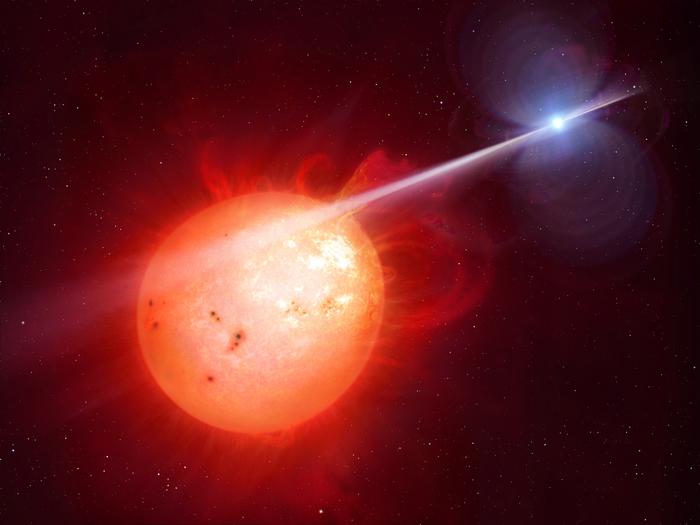
Astronomers have just found a second example of a white dwarf acting as a pulsar, following the first discovery in 2016.

Melting of glaciers to cause flooding and water shortages for nearly 2 billion people who live downstream, report says.


