
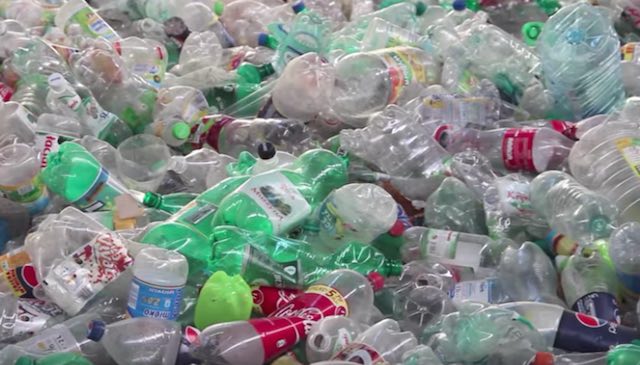
A Dutch organization has just announced plans to salvage plastic pollution from the ocean and use it to build highways in Rotterdam.

In a report entitled The Urban Bio-Loop a company proposes to transform food waste into low-cost and eco-friendly materials.

Pollution kills more people each year than wars, disasters and hunger, also causing huge economic damage, a study says. Almost half the total deaths occur in just two countries.

Tesla has won its first contract with Vestas, the world’s largest wind turbine maker, to supply its Powerpack batteries for the world’s first project to combine solar power, wind power, and Tesla’s storage technology.

Do social pressures cause the evolution of big brains? The debate is ongoing.

An Australian-US team has devised a way to make a broad class of atomically thin metal oxides, including 2D versions of materials already in use by the electronics industry. Their secret is a room temperature liquid metal.

E-cigarettes appear to trigger unique immune responses as well as the same ones that cigarettes trigger that can lead to lung disease, according to a new research.

According to a new analysis, the number of undiscovered and potentially-hazardous asteroids is lower than previously thought.

Thanks to reinforced, pre-stressed concrete and 3D-printing techniques, the bridge (which is primarily intended for cyclists) can safely bear the weight of 40 trucks. In total, the structure took just three months to build.

The total flying insect biomass decreased by more than 75 percent over 27 years in protected areas, according to a study .

Researchers say they have constructed an AI program that can teach itself to play the ancient strategy game at a level far beyond humans.

The world’s first floating wind farm is now feeding into Scotland’s electricity grid.

The company’s Qualcomm Technologies achieved a 5G data connection on a 5G modem chipset for mobile devices—with an emphasis on “mobile.”

30 years on ozone hole healing is proving painfully slow. New discoveries about chemicals not covered by the Montreal protocol are raising fears that full recovery could be postponed into the 22nd century — or possibly even prevented altogether.

According to the World Wildlife Fund said unseasonably extensive amounts of sea ice around the colony forced the adult penguins to travel further than normal to forage for food. The babies did not survive the parents' journeys.


