

More than 300 forest and peatland fires are blazing across Indonesia, prompting government officials to ask people to work from home. A prolonged dry season has caused higher risks of wildfires.

Solving the mystery of how planets like Earth were formed is an important question for understanding the origin of life.

A similar solar storm today would be catastrophic for modern technological society—potentially wiping out telecommunications and satellite systems, causing massive electricity grid blackouts, and costing us billions of pounds.

A Spanish company launched the country's first private rocket on Saturday in a step towards bringing Spain into the exclusive club of space-faring nations.

Psychologists have revealed a profound connection between the spirituality of science and positive wellbeing, much like the benefits traditionally associated with religion.

The energy of these gamma rays clocked in at 20 tera-electronvolts, or about ten trillion times the energy of visible light.

Researchers at MIT have achieved a significant leap in quantum computing, bringing the potential of these supercomputers closer to realization.

Late last year, a communications satellite BlueWalker 3 became one of the brightest objects in the night sky, outshined only by the Moon, Venus, Jupiter and seven stars, according to new research.

The Nobel Prize in physics was awarded Tuesday to three scientists who look at electrons in atoms during the tiniest of split seconds.

Mercury has shrunk by7 km. Most of this happened long ago, but now we have evidence that it continues.

A research team has now found that climate change has a much greater impact on the intensity and frequency of heat extremes in the soil than in the air.

This year’s Nobel Prize in Physiology or Medicine has been awarded to biochemist Katalin Karikó and immunologist Drew Weissman for discoveries that enabled the development of mRNA vaccines against COVID-19.

Two large research collaboration have observed these neutrinos for the very first time, using detectors located at CERN's Large Hadron Collider (LHC) in Switzerland.

In 250 million years, for the first time since Pangea cracked apart, the continents of Earth will crash together into a new supercontinent dubbed Pangea Ultima.
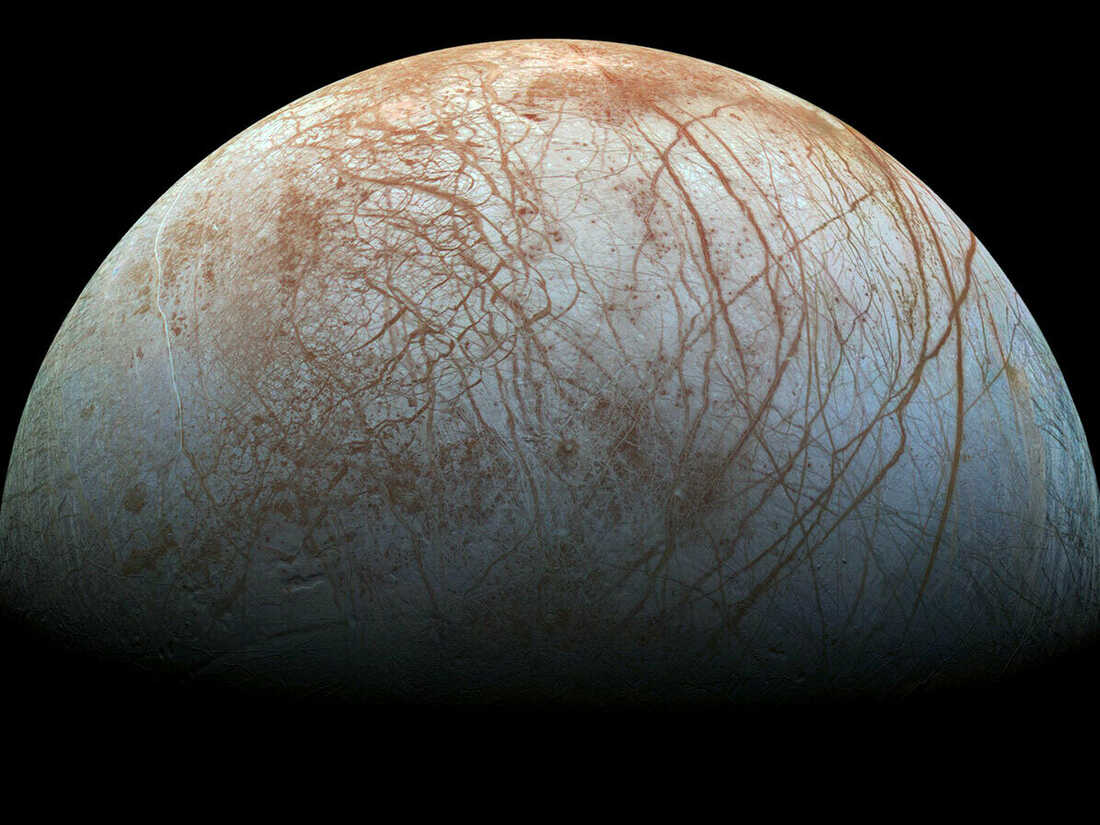
Now, using the James Webb Space Telescope, astronomers have found carbon on Europa’s surface, which likely originated in this ocean. The discovery signals a potentially habitable environment in the ocean of Europa.


