

Astronomers have spotted three supermassive black holes (SMBHs) at the center of three colliding galaxies a billion light years away from Earth. That alone is unusual, but the three black holes are also glowing in x-ray emissions.

An international team of astronomers led by the University of Tokyo used ALMA to view 39 previously-undiscovered ancient galaxies, a find that could have major implications for astronomy and cosmology.

Researchers have clarified one of the mysteries of 2018 in the field of extragalactic astrophysics: the supposed existence of a galaxy without dark matter. New results show that the galaxy is "normal" with dark matter present.

Hubble’s latest contribution comes in the form of a deep-sky mosaic image that was constructed using 16 years’ worth of observations. Known as the “Hubble Legacy Field“ it contains roughly 265,000 galaxies.

Researchers from Yale University claim to have found stronger evidence to confirm that galaxies with little or no dark matter do really exist.
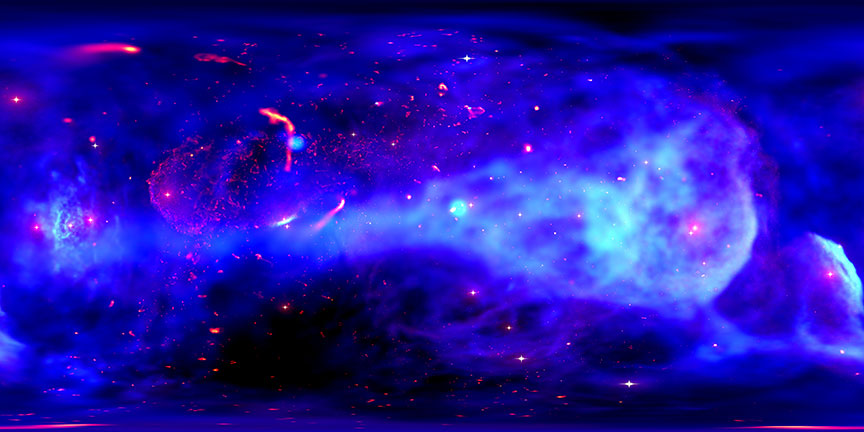
This 360-movie offers an unparalleled opportunity to look around the center of the galaxy, from the vantage point of the central supermassive black hole, in any direction the user chooses.

Using ESA's Gaia spacecraft and NASA’s Hubble Space Telescope, astronomers have come up with the most accurate measurement yet of the Milky Way’s total mass. It contains about 1.5 trillion times the mass of Earth’s Sun.

Located in the constellation of Hercules, about 230 million light-years away, NGC 6052 is a pair of colliding galaxies. This particular image was taken using the Wide Field Camera 3 on the NASA/ESA Hubble Space Telescope.
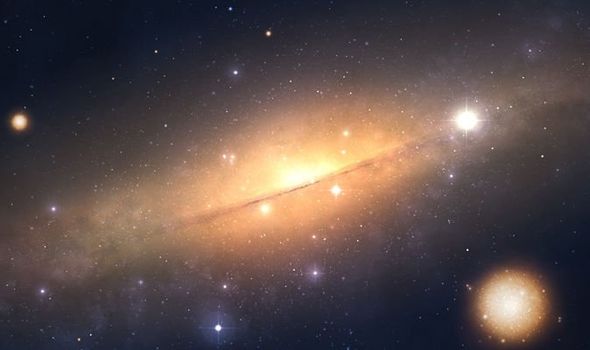
A release of data gathered by the Low Frequency Array (LOFAR) telescope network in Europe has discovered more than 300,000 potential galaxies in a tiny corner of the northern sky.

A new sky survey project, The Zwicky Transient Facility (ZTF), has released its first round of incredible data, results, and images, including this amazing new view of our neighboring Andromeda galaxy.

A duo of astronomers has spotted three new globular clusters in the Milky Way’s bulge, a 10,000-light-year-wide central structure made primarily of old stars, gas and dust.

Astronomers using the NASA/ESA Hubble Space Telescope have made an unexpected finding. They discovered a dwarf galaxy in our cosmic backyard, only 30 million light-years away.

The Hubble Space Telescope's has managed to take the most detailed image yet of our Local Group neighbour - the Triangulum galaxy, also known as Messier 33, or NGC 598, located 3 million light years away.

Scientists have found evidence that dark matter can be heated up and moved around, as a result of star formation in galaxies. The findings provide the first observational evidence for the effect known as 'dark matter heating'.

ALMA data show the most luminous galaxy in the universe has been caught in the act of stripping away nearly half the mass from at least three of its smaller neighbors.


