

The European Space Agency’s Gaia spacecraft has produced the most accurate star catalogue ever assembled, including high-precision measurements of the brightness and positions of some 1.7 billion stars.

The team detected the blue supergiant star — which shone when the universe was just one-third its current age — with the help of both the Hubble Space Telescope and gravitational lensing.

A small team of researchers announced that its correspondingly small telescope picked up a signal produced by the very first stars in our Universe.
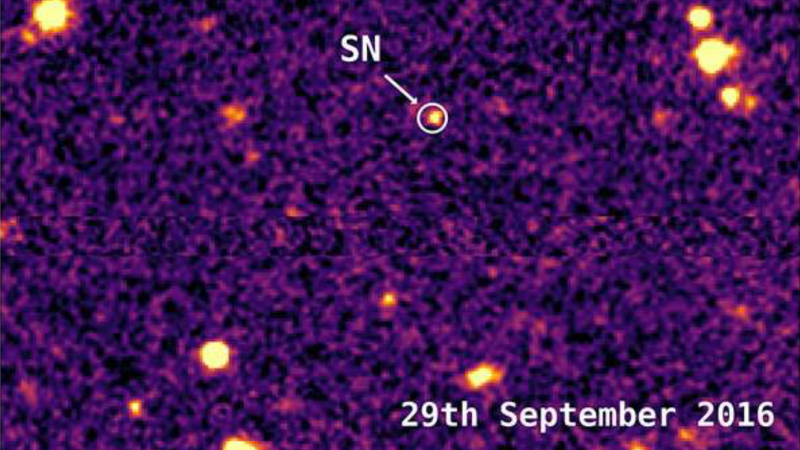
On August 22, 2016, astronomers spotted a superluminous supernova whose light traveled over 10 billion years to reach us.

The Hubble Space Telescope shows a “sparkling jewel box full of stars,” NASA says, in the central bulge of the Milky Way, with more plentiful bright blue stars in the foreground.

Thanks to a new study by a team of Spanish researchers, the oldest star in the Milky Way may have finally been discovered.

New ALMA telescope observations have uncovered the surprisingly clear chemical "fingerprints" of the complex organic molecules methanol, dimethyl ether, and methyl formate.
An international team of astronomers has produced the first detailed images of the surface of a giant star outside our solar system.

Contrary to what was expected, a team of astronomers has discovered that kilonova event has been brightening ever since it first appeared.
As our sun gets older, it's losing mass, and so its gravitational pull becomes weaker. As a result, the orbits of all the planets in our solar system are expanding.
Roughly 1300 light-years from Earth lies the Orion Nebula. A team at the Space Telescope Science Institute (STScI) in US created this zoom into the stellar nursery and a 3D visualization.
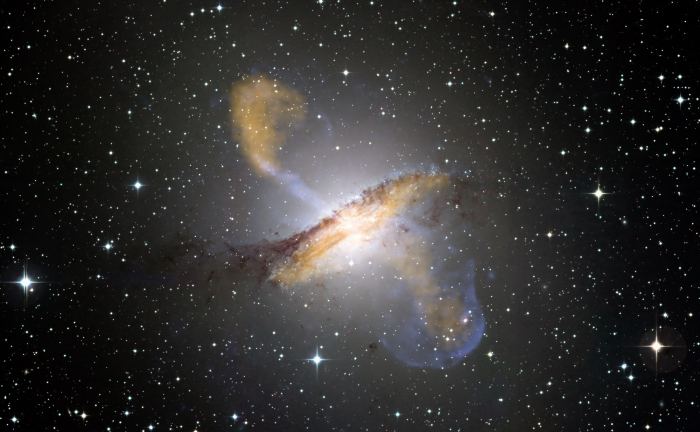
A new study by a team of international astronomers has provided the first direct evidence that supermassive black holes affect star formation in their galaxies.

GJ436, a red dwarf located about 33 light-years from Earth has a planet that behaves very much like a comet. And according to a recent study this planet also has a very peculiar orbit.
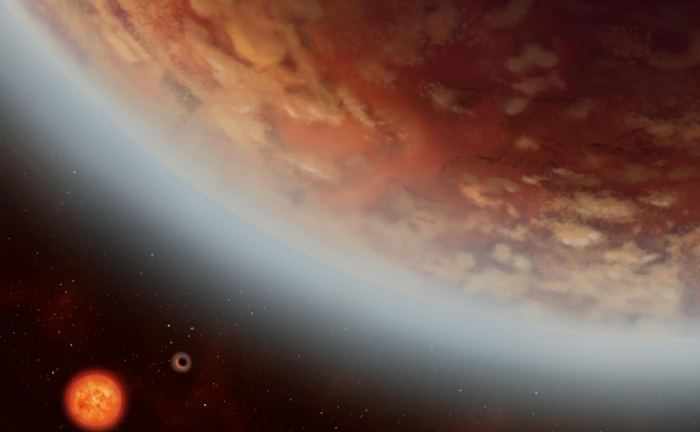
While examining a previously-discovered exoplanet, an international team of astronomers discovered a second Super-Earth around the star.

ALMA has revealed signs of eleven low-mass stars forming perilously close — within three light-years — to the Milky Way’s supermassive black hole, known to astronomers as Sagittarius A*.


