

Thanks to a new study by a team of Spanish researchers, the oldest star in the Milky Way may have finally been discovered.

The simulation consists of 18 simulations covering various scales - each a cubic mock-up of space up to 1 billion light years wide - tracing the evolution of the Universe from just after the Big Bang into the future.

New ALMA telescope observations have uncovered the surprisingly clear chemical "fingerprints" of the complex organic molecules methanol, dimethyl ether, and methyl formate.
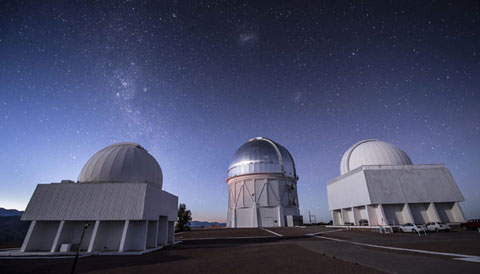
Results from the first data release of the Dark Energy Survey include eleven new stellar streams in the Milky Way galaxy.

InSight is the next member of what could be called a fleet of human vehicles destined for Mars. The mission will try to understand the deeper structure of Mars.

This was the "Humanity Star," a disco ball-like geodesic sphere, which measures about 1 meter in diameter. It is reflecting a philosophy that by going into space, humans can improve our lives on Earth.

It’s been less than a year since astronomers detected TRAPPIST-1, a remarkable star system located 39 light years from Earth. New research suggests life could take root on at least two of these planet.

The Xinjiang Qitai 110-meter Radio Telescope ( QTT ) could help advance research on dark matter, gravitational waves, and extraterrestrial intelligence.
An international team of astronomers has produced the first detailed images of the surface of a giant star outside our solar system.

Contrary to what was expected, a team of astronomers has discovered that kilonova event has been brightening ever since it first appeared.
As our sun gets older, it's losing mass, and so its gravitational pull becomes weaker. As a result, the orbits of all the planets in our solar system are expanding.

It's Surprisingly Like Earth. Saturn moon's three biggest puddles have a common equipotential surface – a sea level, just like our own oceans.

Galaxy cluster ACT-CLJ0102-4915, or “El Gordo” contains the mass of a staggering three million billion suns. It is the largest, hottest, and brightest X-ray galaxy cluster ever discovered in the distant Universe.
Roughly 1300 light-years from Earth lies the Orion Nebula. A team at the Space Telescope Science Institute (STScI) in US created this zoom into the stellar nursery and a 3D visualization.

Researchers have identified eight, massive sheets of ice just below the Martian surface, and they appear to be relatively young deposits.


