
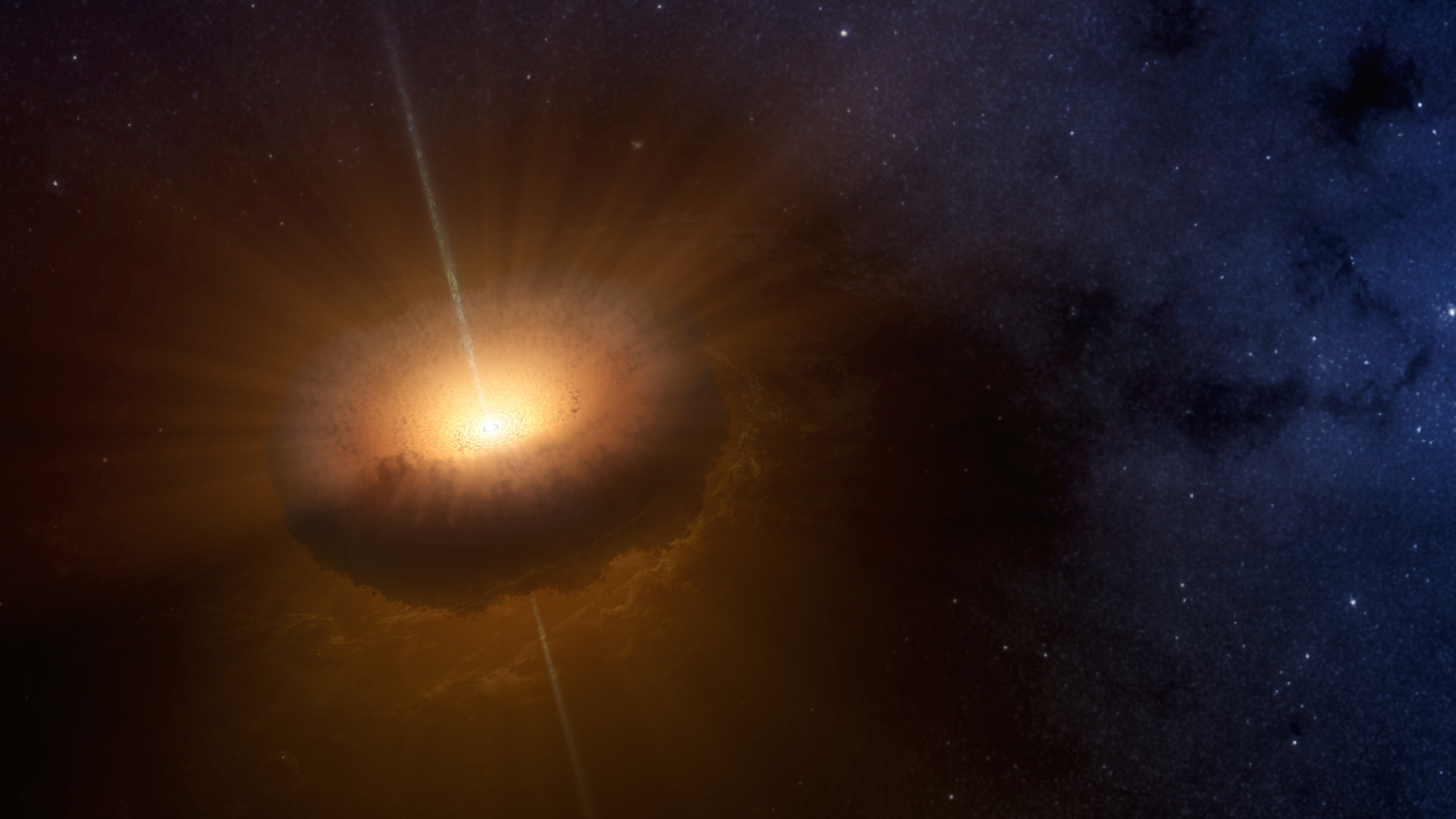
In 2009 astronomers detected an unusual object, named CX330, as a source of X-rays as it was surveying the center of the Milky Way galaxy but they had not idea what it was. Today, astronomers have a better idea to what this strange object is.

Astronomers at last have a clear glimpse of the eye of a massive celestial storm.

To find out what's going on around the weirdest star in the galaxy, astronomers are turning to crowdfunding.

Amelia Stutz and Andrew Gould from the Max Planck Institute for Astronomy in Heidelberg are bringing gravity and magnetic fields into play. To test their idea, they undertook a detailed investigation of the Orion Nebula, 1300 light-years away.
Currently the best place to search for life beyond the solar system. TRAPPIST-1 is an ultracool dwarf star -- it is much cooler and redder than the Sun and barely larger than Jupiter.

Crisp, clear images of a "hot Jupiter" system captured by a physicist were vital in determining that a newly found planet inhabits a three-star system, a phenomenon documented only a few times before.

While we sit here on Earth looking up in wonder at how awesome our star, the Sun, is, astronomers have just found a stable planet inside a triple-star system that makes our Solar System seem rather boring.

Astronomers report that they have observed the most luminous galaxies ever seen in the Universe, objects so bright that established descriptors such as 'ultra-' and 'hyper-luminous' used to describe previously brightest known galaxies don't even come close.

Research has found new persuasive evidence that could help solve a longstanding mystery in astrophysics: why did the pace of star formation in the universe slow down some 11 billion years ago?
This animation is based on photometric observations made by NASA’s Kepler space telescope. By closely monitoring the star KSN 2011d, located 1.2 billion light-years away, Kepler caught the onset of the early flash and subsequent explosion.

Astronomers have found the largest known solar system, linking together a star and what was thought to be a free-floating 'lonely planet' in orbit some 1 trillion (1 million million) kilometres away from its sun.

Someone hug Interstellar’s science advisor. Just like in the film, a new study finds that a black hole with exactly the right temperature could serve as a cold sun and even support complex lifeforms.
Origin of exploding star that is twice as luminous as any other remains unclear. Seven months after it was first spotted, a puzzle still hangs over the origin of the brightest supernova ever seen.
Like a blinding beacon lighting up the night, a powerful gamma-ray-generating stellar husk has been seen pulsating in a neighboring galaxy.

Astronomers at the University of Maryland, observed the event, which is the closest tidal disruption discovered in about a decade.


