
One of the top engineers working on NASA's controversial EM Drive thruster at the Eagleworks Laboratory at the Johnson Space Center in Texas has spoken publicly about the current state of the project. This is the first direct update in months, as NASA is keeping a very tight lid on the developments.
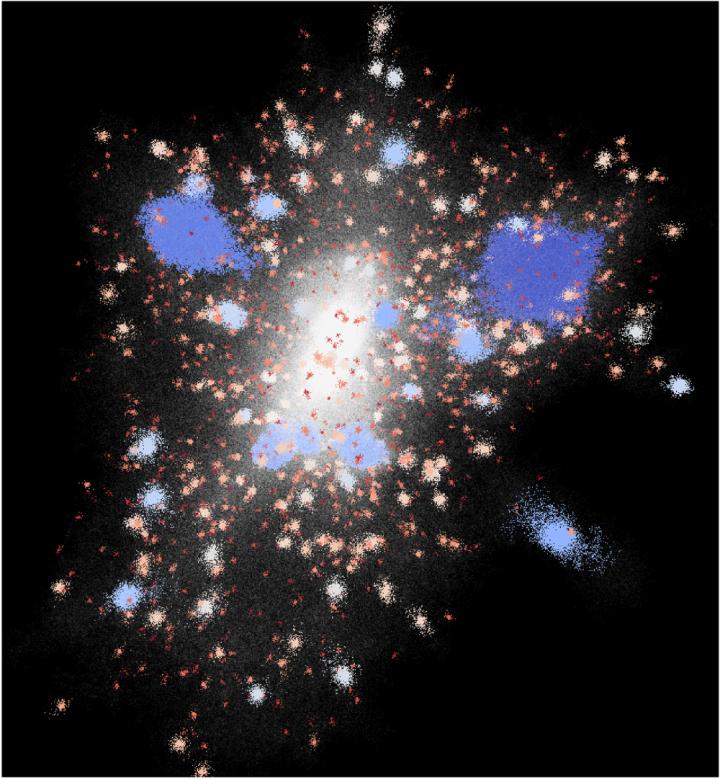
Galaxies have halos surrounding them, which may be composed of both dark and regular matter. This image shows a substructure within a halo in the Q Continuum
Science fiction literature is full of stories in which tunnels in space-time known as wormholes are used for time travel. How much fact lies within the fiction? The answer is, more than you might think.

The world's fourth-largest optical telescope has a new experiment coming online.

The Eagle Nebula and the Star Queen nebula can be seen in this annotated view.

If our Galaxy truly contains many intelligent civilizations, some of which may be ahead of us by a billion years, how is it possible that we have not seen any sign of them yet? Nobody knows the answer to this so-called "Fermi Paradox," but..

Spectacular new Hubble Space Telescope images reveal 250 previously unknown galaxies that formed just 600 million years after the Big Bang.

Humans may feel small when contemplating the universe, but astronomers are closer than ever to at least making us feel a little less lonely thanks to a new method of measuring planetary habitability and advances in telescope technology.
The James Webb Space Telescope (JWST), as the largest space-based astronomical observatory with near- and mid-infrared instrumentation, will elucidate many mysterious aspects of comets.

Some 300 hot Jupiters have been identified over the past two decades, and this is the first time any close-in planets were discovered.

The new field of exoplanet science has progressed rapidly in the last two decades: Astronomers have now confirmed the existence of nearly 2,000 planets beyond our own solar system.

Astronomers at the University of Maryland, observed the event, which is the closest tidal disruption discovered in about a decade.

For decades, Alan Stern talked about how important it was to send a spacecraft to Pluto. Those speeches, given to any audience willing to lend an ear, helped build up support for a mission to what was once classified the ninth planet, maintain support once NASA agreed to fly a mission after previous efforts foundered, and to retain interest once New Horizons was on its long cruise to Pluto.

Dr Amitabha Ghosh, who has worked in multiple Mars missions of National Aeronautics and Space Administration (Nasa) since the US launched the Mars Pathfinder spacecraft in 1996, believes that one day space travel will become "affordable".

Five possible space missions have been selected by NASA to receive preliminary funding, ahead of a possible launch as early as 2020. Each of the projects, chosen as part of NASA


