
Dwarf planet Ceres is shown in these false-color renderings, which highlight differences in surface materials. Images from NASA’s Dawn spacecraft were used to create a movie of Ceres rotating, followed by a flyover view of Occator Crater, home of Ceres’ brightest area.

Physicists have firmed up a theoretical limit on the mass of a black hole by figuring out when it will disrupt the disc that feeds it.

Astrophotographer Ron Brecher took this image of IC 417, known as the spider nebula, from Guelph, Ontario.
For the first time, astronomers have directly observed a planet in the making.
NASA's Cassini spacecraft has detected a massive, never-before-seen icy cloud at the south pole of Saturn's huge moon Titan.
Some want to scrap adjustment that keeps atomic time in sync with Earth

Five weeks of mapping at sea suggests two possible origins for the underwater Tamu Massif.

Astronomers observe up to three newborn planets evolving from a disk of gas and dust particles circling a distant Sun-like star.
There is a peculiar system 1,600 light-years from our solar system. It is composed of two brown dwarfs, massive objects too big to be planets and too small to fuse hydrogen and become stars. But that is not the strange part: Scientists have now discovered a Venus-sized planet around the smaller brown dwarf.
Animation showing the deployment, and operation of a Lunar Space Elevator.

PKS 1302-102 is one of the few known quasars with a pair of black holes within its accretion disc. It is also a curious case for astronomers as it will produce a powerful explosion when these two black holes merge. The scientists trying to determine the scale of this merger estimate that it could result in an enormous release of energy.

Like a blinding beacon lighting up the night, a powerful gamma-ray-generating stellar husk has been seen pulsating in a neighboring galaxy.

Astronomers have found a rocky planet orbiting a small star that is within easy telescope views from Earth.
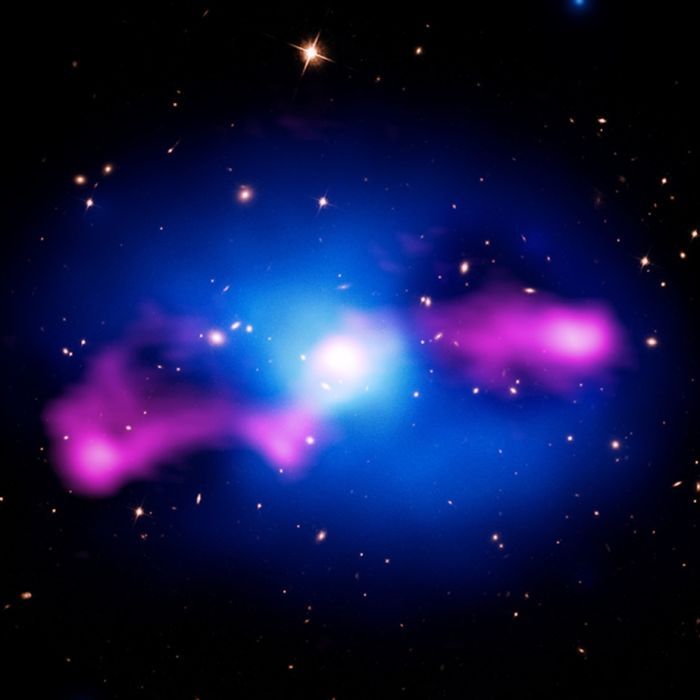
Astronomers capture an image of the continuing eruption of the most powerful explosion since the big bang.

Astronomers from the University of Bonn in Germany, have discovered what appears to be the longest X-ray tail associated with a stripping process from a galaxy on a large scale. This galaxy with the enormous X-ray tail is a member of a galaxy cluster known as Zwicky 8338.


