
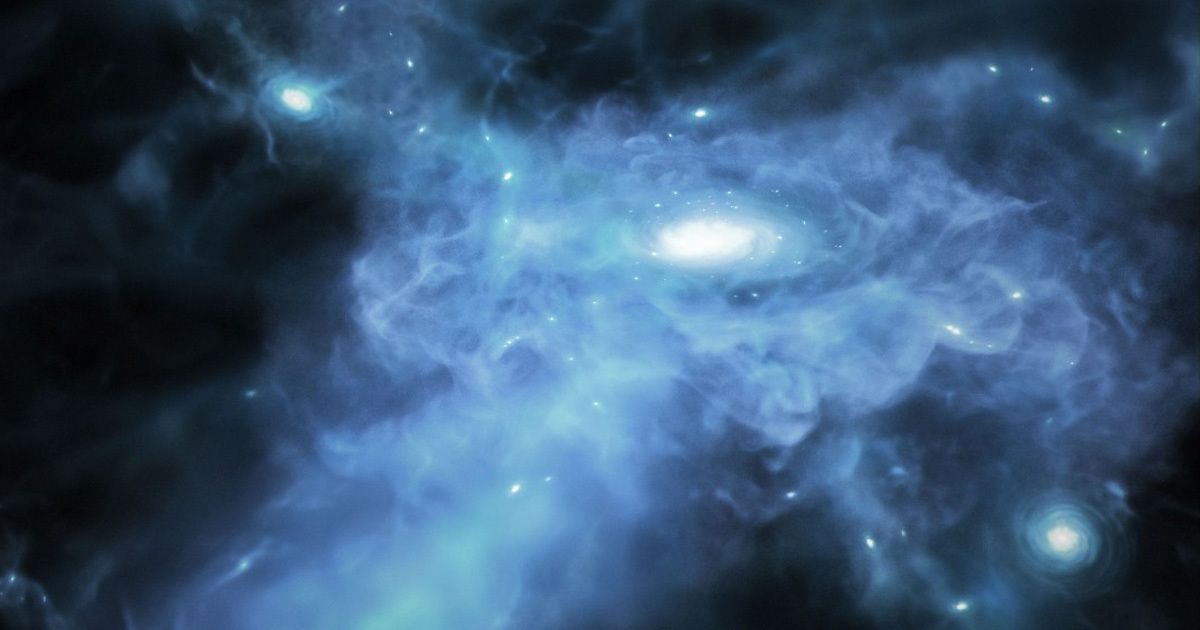
Using the James Webb Space Telescope, researchers observed the birth of some of the youngest galaxies ever witnessed.

A recent study has discovered a novel method for detecting the first-generations stars, known as Population III (Pop III) stars, which have never been directly detected.

According to data from the Hubble and James Webb Space Telescopes, the origins of the free-flying photons in the early cosmic dawn were small dwarf galaxies that flared to life, clearing the fog of murky hydrogen that filled intergalactic space.

NASA's new space telescope spotted a 13 billion-year-old galaxy that is much too complex to exist that early in the Universe.

The gigantic galaxies we see in the Universe today, including our own Milky Way galaxy, started out far smaller.

The beginning of the Universe has always been something of a chicken-and-egg problem. Did stars and galaxies form first, with black holes slowly coalescing in their midst? Or did black holes appear before the first galaxies?

An international team of astronomers has detected for the first time H-alpha emission in individual galaxies during the so-called Epoch of Reionization, or cosmic dawn.

Astronomers using the James Webb Space Telescope (JWST) have detected the earliest known black hole. Located more than 13 billion light-years away, it dates to a mere 400 million years after the Big Bang.

Discovered in 2013 as the source of rampant star formation just 880 million years after the Big Bang, a 'galaxy' named HFLS3 is not a galaxy at all. HFLS3 is actually six galaxies undergoing an epic, giant collision at the dawn of time.

Astrophysicists working with the James Webb Space Telescope (JWST) have found a surprising amount of metal in a galaxy only 350 million years after the Big Bang.

A recent deep field image from the Webb Space Telescope features two galaxies. These galaxies are remarkable for their distance from Earth, being the second and fourth most distant galaxies ever observed.

Two NASA space telescopes teamed up to scrutinize a distant galaxy and discovered something mind-boggling: a gargantuan black hole inside a galaxy that’s more than 13 billion years old.

Astronomers detected the most distant galactic magnetic field so far. The galaxy is called 9io9. Its light has to travel travel more than 11 billion years to reach us, from a time when the universe was a young 2.5 billion years old.

The galaxy, called JD1, is seen as it was when the universe was only 480 million years old, or 4% of its present age.

This observation suggests exciting avenues of investigation into both the production of cosmic dust and the earliest stellar populations in our Universe, and was made possible by Webb’s unprecedented sensitivity.


