

A Saudi Arabian team has achieved a record level of efficiency with what's known as a 'tandem' solar cell: one that combines two different materials.

Scientists have detected sound waves moving through Mars’ core for the first time, offering new clues to the composition of the fourth planet from the Sun.

Launched 19 July 2020 atop a Japanese H-2A rocket, the Hope probe braked into a highly elliptical orbit around Mars on 9 February 2021. The first such close encounter came in late January.

Mounting evidence is pointing to the world having entered a sixth mass extinction. If the current rate of extinction continues we could lose most species by 2200.

Italian researchers have created the first-ever rechargeable battery from food ingredients. This invention could potentially power small diagnostic devices used to internally diagnose health conditions.

In a new study researchers describe how creatures that are normally found along coastlines, not the open ocean, have made their homes on floating trash in the Pacific Ocean.

Some of the asteroids NASA's Lucy mission will visit are still more than 330 million miles away from the spacecraft, but despite the great distance and the comparatively small sizes, Lucy caught views of four of its targets in late March.

A paper published in Nature Aging describes how cold temperatures stimulate the production of PA28γ, a protein that appears to increase lifespan in worms and cells.
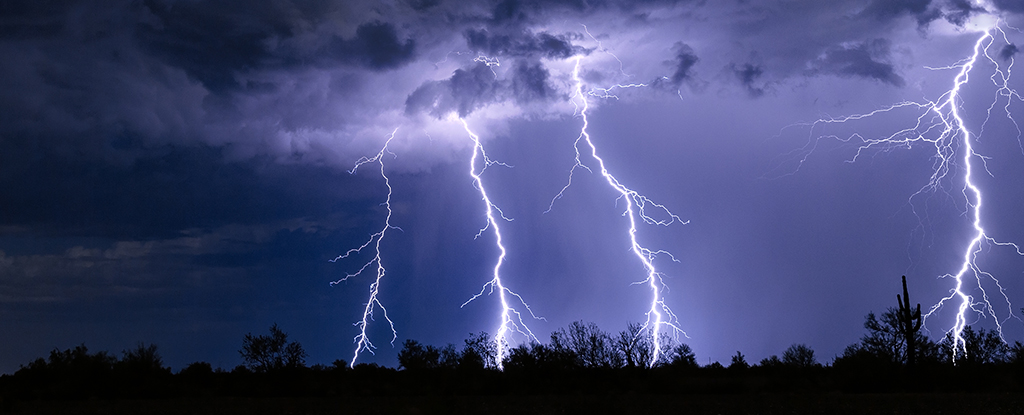
A lightning bolt has produced a fascinating type of phosphorus material - a close match for calcium phosphite (CaHPO3). We have never seen this material occur naturally on Earth – minerals similar to it can be found in meteorites and space.

The extraordinary material has set a new record for exhibiting magnetoresistance at room temperature.

The number of humans on Earth reached 8 billion in November 2022. Now a new report suggests that the world's population may peak at just 9 billion by 2050, a number far lower than previously thought.

The James Webb Space Telescope has discovered the four most distant galaxies ever observed, one of which formed just 320 million years after the Big Bang when the universe was still in its infancy, new research said on Tuesday.

Since 1993, the seas rose by a total of 9.1 centimeters. Two years ago, it went up by 0.27 centimeters. That one-year rise from 2021 to 2022 may sound small by comparison, but it's a harbinger.

U.S. recent study revealed a layer between the Earth's core and the mantle that is likely a dense, yet thin, sunk ocean floor.

Plastic-munching bacteria capable of breaking down plastic waste in a matter of hours have attracted much attention lately as a microscopic solution to the world's growing plastic problem.


